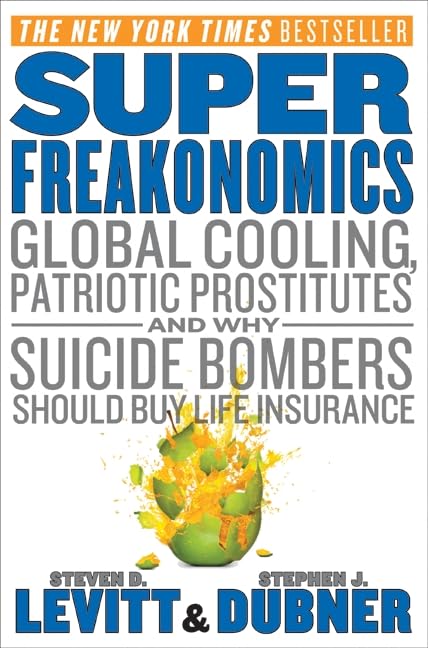
Superfreakonomics : global cooling, patriotic prostitutes, and why suicide bombers should buy life insurance / Steven D. Levitt & Stephen J. Dubner.
Material type: TextPublisher: New York : William MorrowCopyright date: ©2009Edition: First editionDescription: xvii, 270 pages ; 24 cmContent type:
 - text
- unmediated
- volume
- General
- 9780060889579
- 330 22
- HB74.P8 L4797 2009
| Item type | Current library | Collection | Call number | Status | Barcode | |
|---|---|---|---|---|---|---|
 Books
Books
|
John Tomay Memorial Library | ANF | 330 LEV (Browse shelf(Opens below)) | Available | 31030100005487 |
Includes bibliographical references (p. [221]-256) and index.
How is a street prostitute like a department-store santa? -- Why should suicide bombers buy life insurance? -- Unbelievable stories about apathy and altruism -- The chlorine solution and the jellyfish fix -- What do Al Gore and Mount Pinatubo have in common? -- Epilogue : monkeys are people too.
he New York Times best-selling Freakonomics was a worldwide sensation, selling over four million copies in thirty-five languages and changing the way we look at the world. Now, Steven D. Levitt and Stephen J. Dubner return with SuperFreakonomics, and fans and newcomers alike will find that the freakquel is even bolder, funnier, and more surprising than the first. Four years in the making, SuperFreakonomics asks not only the tough questions, but the unexpected ones: What's more dangerous, driving drunk or walking drunk? Why is chemotherapy prescribed so often if it's so ineffective? Can a sex change boost your salary? SuperFreakonomics challenges the way we think all over again, exploring the hidden side of everything with such questions as: How is a street prostitute like a department-store Santa? Why are doctors so bad at washing their hands? How much good do car seats do? What's the best way to catch a terrorist? Did TV cause a rise in crime? What do hurricanes, heart attacks, and highway deaths have in common? Are people hard-wired for altruism or selfishness? Can eating kangaroo save the planet? Which adds more value: a pimp or a Realtor? Levitt and Dubner mix smart thinking and great storytelling like no one else, whether investigating a solution to global warming or explaining why the price of oral sex has fallen so drastically. By examining how people respond to incentives, they show the world for what it really is good, bad, ugly, and, in the final analysis, super freaky.
There are no comments on this title.