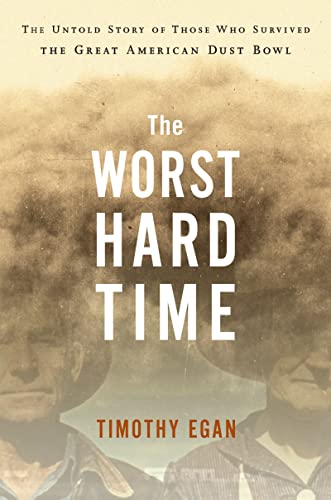
The worst hard time : the untold story of those who survived the great American dust bowl / Timothy Egan.
Material type: TextPublisher: Boston : Houghton Mifflin Co.Copyright date: ©2006Description: x, 340 pages : illustrations, map ; 24 cmContent type:
 - text
- unmediated
- volume
- General
- 9780618346974
- 061834697X
- 978/.032 22
- F595 .E38 2006
| Item type | Current library | Collection | Call number | Status | Barcode | |
|---|---|---|---|---|---|---|
 Books
Books
|
Idaho Springs Public Library | ANF | 978.03 EGA (Browse shelf(Opens below)) | Available | 3ISPL00204570R | |
|
Books
|
John Tomay Memorial Library | ANF | 978.03 EGA (Browse shelf(Opens below)) | Available | 3GTPL00063245S |
Browsing Idaho Springs Public Library shelves Close shelf browser (Hides shelf browser)


Includes bibliographical references (p. 315-327) and index
On April 14, 1935, the biggest dust storm on record descended over five states, from the Dakotas to Amarillo, Texas. People standing a few feet apart could not see each other; if they touched, they risked being knocked over by the static electricity that the dust created in the air. The Dust Bowl was the product of reckless, market-driven farming that had so abused the land that, when dry weather came, the wind lifted up millions of acres of topsoil and whipped it around in "black blizzards," which blew as far east as New York. This ecological disaster rapidly disfigured whole communities. Egan's portraits of the families who stayed behind are sobering and far less familiar than those of the "exodusters" who staggered out of the High Plains. He tells of towns depopulated to this day, a mother who watched her baby die of "dust pneumonia," and farmers who gathered tumbleweed as food for their cattle and, eventually, for their children.
There are no comments on this title.