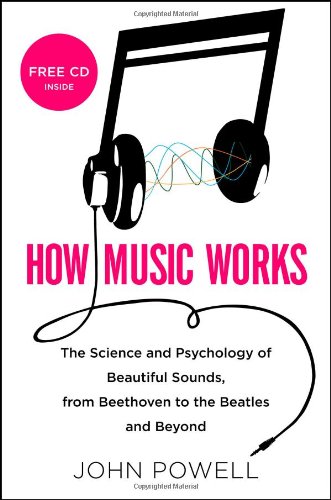
How music works : the science and psychology of beautiful sounds, from Beethoven to the Beatles and beyond / John Powell.
Material type: TextPublisher: New York, NY : Little, Brown, 2010Edition: First U.S. editionDescription: vi, 264 pages : illustrations, music ; 22 cm. + 1 sound disc (digital ; 4 3/4 in.)Content type:
 - text
- performed music
- unmediated
- audio
- volume
- audio disc
- General
- 9780316098304 (hc.)
- 0316098302 (hc.)
- 781 22
- 781 14
- ML3805 .P69 2010
| Item type | Current library | Collection | Call number | Status | Barcode | |
|---|---|---|---|---|---|---|
 Books
Books
|
Idaho Springs Public Library | ANF | 781 POW (Browse shelf(Opens below)) | Available | 30404100029022 |
Includes bibliographical references (p. [255]-257) and index.
So, what is music, anyway? -- What is perfect pitch and do I have it? -- Notes and noises -- Xylophones and saxophones : same notes but different sounds -- Instrumental break -- How loud is loud? -- Harmony and cacophony -- Weighing up scales -- The self-confident major and the emotional minor -- I got rhythm -- Making music -- Listening to music -- Fiddly details. Naming and identifying intervals ; Using the Decibel system ; Tuning an instrument to the pentatonic scale ; Calculating equal temperament ; The notes of the major keys.
Accompanying CD: How to get different sounds from a guitar string -- Can you guess what this instrument is? -- Why some notes clash and others get along together -- Different ways to accompany a tune -- Ancient and modern scales -- 3,000-year-old music : ancient harp tuning -- The horrible out-of-tune bamboo whistle -- Confident majors and emotional minors -- How to bring tears to the eyes of the audience -- The magnificent drinking-straw oboe.
John Powell, a scientist and musician, answers questions about harmony, timbre, keys, chords, loudness, musical composition, and many more in this intriguing and original guide to acoustics.
A physicist-musician offers an accessible guide to the science and psychology lurking beneath the surface of music, covering harmony, chords, volume, and musical composition.
There are no comments on this title.